Welcome to
1,381 people live in St. Michaels, where the median age is 49.8 and the average individual income is $56,901. Data provided by the U.S. Census Bureau.
Total Population
Median Age
Population Density
Average individual Income
St. Michaels sits on a narrow neck of land on Maryland's Eastern Shore, wrapped on nearly every side by the tidal waters of the Miles River. That geography explains almost everything about the town — why the streets are flat and short, why nearly every conversation eventually turns to the water, and why a town of roughly a thousand year-round residents supports marinas capable of handling 200-foot yachts.
The town sits in Talbot County, the most affluent and most historically dense county on the Shore. Easton, the county seat, is ten miles east and handles the practical side of life: hospital, grocery stores, airport. St. Michaels handles the rest.
Locals will tell you the story of the 1813 British bombardment, and it's worth knowing because you'll hear it a dozen times. Residents reportedly hung lanterns high in the trees and ship masts on the town's edge while dimming lights below, and British gunners aimed at the false lights and sent their cannonballs sailing over the rooftops. Hence "The Town That Fooled the British." Whether it happened exactly that way is debated. That it's still the town's calling card two centuries later tells you something about how St. Michaels relates to its own history.
As for who actually lives here now: retirees who spent careers in Washington or Baltimore and finally made the move permanent; second-home owners from the D.C.–Baltimore corridor who come down Thursday night and leave Sunday afternoon; sailors who chose the town for the water first and the town second; and a smaller, quieter population of families and working residents who have been here for generations. The Inn at Perry Cabin and the Chesapeake Bay Maritime Museum bring in a steady flow of visitors, some of whom eventually become buyers. That progression — visitor, repeat visitor, second-home owner, full-time resident — describes a large share of the people I work with.
St. Michaels is a small, high-value market, and small markets move differently than large ones. A handful of transactions can swing the median in either direction, so treat these numbers as a frame rather than a verdict.
Metric | Where the 21663 market sits |
|---|---|
Median home price | $900,000 – $1.18M, depending on the mix of in-town vs. waterfront sales |
Price per square foot | Roughly $460 – $470 |
Days on market | 65 – 105 days |
Active inventory | Low to moderate, around 50 listings across the zip code |
Ownership pattern | Second-home dominant |
The number that matters most is the last one. A significant share of St. Michaels single-family homes function as weekend retreats or seasonal residences rather than primary homes. That single fact drives several others.
It keeps entry-level inventory tight, because second-home buyers rarely need to sell on a timeline — a house that doesn't get its price simply comes off the market and goes back on next spring. It lengthens days on market, because the buyer pool for a $2M waterfront estate is national rather than local and takes time to assemble. And it means bidding wars are the exception here, not the rule. This is a market where a well-priced house finds its buyer in two or three months and an overpriced one sits for a year.
For buyers, that pace is a gift. You will usually have time to inspect, to verify water depth, to pull an elevation certificate. For sellers, it means pricing accuracy in the first thirty days matters more than in almost any market I work in.
Historic in-town houses. Concentrated along Mulberry, Chestnut, and East Talbot streets, these run from the 18th century through the early 20th — Colonial, Federal, and Victorian, with heart-pine floors and brick chimneys still intact in many of them. You trade lot size and off-street parking for the ability to walk to dinner. Expect small yards, street parking, and design review on anything you change outside.
Waterfront estates. These sit along the Miles River, St. Michaels Harbor, and Broad Creek, often on multiple acres with private deep-water piers, guest houses, and substantial water frontage. This is the top of the market and where out-of-area buyers concentrate.
Cottages. Found both in town and in water-access subdivisions like Rio Vista. Some are restored fishermen's cottages; others are 1950s–70s ranches that have been updated to varying degrees. This is where the most attainable pricing in the zip code lives.
Condos and townhomes. Mostly in planned communities like Martingham or in harbor-front buildings. The appeal is straightforward: a lock-and-leave second home with a boat slip, a pool, or golf attached, and no lawn to worry about from November to April.
Land and building lots. Increasingly rare. What comes available usually sits just outside town limits or inside established subdivisions, and construction requires clearing environmental and setback review before a shovel moves. Buying land here is a project, not a shortcut.
This is the section I'd read twice if you're new to the Shore. Waterfront in Maryland carries a layer of regulation and physical due diligence that most buyers coming from inland markets have never encountered, and the difference between two properties that look identical in photos can be enormous.
Protected coves versus open water. Inner harbors and back creeks — San Domingo Creek, the Miles River coves — give you calm anchorage, minimal wave action, and real protection during storms. The trade-off is silting and shallower water. Open-water frontage on the Miles or toward Eastern Bay gives you unobstructed views and immediate deep-water access, at the cost of wind exposure, shoreline erosion, and harder wear on docks and bulkheads. Neither is better. Which one is right depends entirely on your boat and your tolerance for maintenance.
Docks and piers. Talbot County and Maryland State regulations generally allow one main pier per legally subdivided lot. Standard design allowances cap the main pier at six feet wide, with up to two three-foot finger piers on the landward end. Mooring configurations are limited to a maximum of six mooring piles, four boat lifts, or four slips. One critical detail buyers miss: in subdivisions created after March 27, 1990 that have community piers, individual private piers are generally prohibited. If a listing implies you can add a pier, verify it before you write the offer.
Depth at mean low water. MLW — the average low-tide water level — is the number that determines whether your boat fits. Powerboats generally need three to four feet at MLW. Deep-draft sailboats and larger motor yachts need six feet or more. Verify the depth at the dock and all the way out through the fairway and channel to open water, because a deep slip at the end of a shallow channel is a slip you can only use at high tide. Dredging permits are heavily regulated and difficult to secure, so buying with the plan to dredge later is a plan I'd advise against.
Critical Area regulations. Maryland's Critical Area Law governs all land within 1,000 feet of tidal waters and tidal wetlands. Inside that, a 100-foot buffer applies landward from the mean high water mark, and it can expand where slopes are steep. New construction, additions, tree and vegetation clearing, and new impervious surfaces — patios, driveways, pool decks — all require county zoning approval and, frequently, mitigation plans. If your plan for a property involves an addition or a pool, get an answer on Critical Area feasibility during your inspection period, not after settlement.
Flood zones and insurance. Most low-lying land here sits in a FEMA flood zone, commonly AE or coastal VE, and flood insurance is mandatory on mortgaged properties in those zones. Pull the elevation certificate early. Homes built above Base Flood Elevation, or retrofitted with proper flood vents, carry dramatically lower premiums than identical-looking homes that aren't. The difference between $900 and $4,500 a year is a real factor in what you can afford to pay for the house.
In-town St. Michaels is genuinely walkable in a way very few small American towns still are. From most historic-district addresses you can reach Talbot Street's shops, restaurants, and seafood counters, the Chesapeake Bay Maritime Museum, and the harbor parks on foot. Residents here routinely go days without starting the car.
The architecture reflects roughly 150 years of American coastal building — maritime Colonial cottages, Federal-style townhouses, ornate Victorians with deep front porches, and a good number of houses that have been added onto in three different centuries. Original heart-pine flooring and exposed brick chimneys are common. So are old windows, old wiring, and old plumbing, which is worth budgeting for.
The important thing to understand before you buy in-town: properties inside the designated Historic District fall under the St. Michaels Historic District Commission. Exterior changes — paint colors, window replacements, siding materials, additions, roof work — require HDC design review and approval. This is not a formality. It preserves exactly the character that makes the district valuable, and it also means your renovation timeline includes a review process. Buyers who go in understanding this are happy. Buyers who discover it after closing are not.
Martingham — Just north of town, built around the Links at Perry Cabin golf course. A mix of custom single-family homes, townhomes, and low-maintenance golf villas among mature trees and ponds. Popular with buyers who want amenity living without the maintenance burden of a waterfront estate.
Rio Vista — An established water-access subdivision south of downtown along San Domingo Creek. Mid-century ranches, updated cottages, and newer custom homes, with a voluntary community association, a boat launch, and a kayak dock. One of the better value propositions in the zip code for buyers who want water access without waterfront pricing.
Bentley Hay — A quiet upscale enclave close to town. Larger custom-built homes on generous landscaped lots with underground utilities, and still within walking distance of Talbot Street. It's the compromise for buyers who want a newer house and a real yard but aren't ready to give up walkability.
Deep Water Point — A waterfront peninsula community on the Miles River, and the name is accurate. Deep-water dockage, large coastal estates, expansive river views. This is where serious boaters look first.
Long Haul Creek — Sheltered water off the Miles River, with protected anchorages, private piers, and substantial estates set in wooded, quiet surroundings. Calmer water than Deep Water Point, more privacy, less open-water view.
Harbor-front condominiums — Communities like Harbourtowne and The Harbour offer low-maintenance living directly on St. Michaels Harbor, typically with assigned slips, private balconies, and a short walk to downtown. This is the most efficient path to a St. Michaels second home for buyers who want the boat and the town without a building to maintain.
The neck of Talbot County surrounding St. Michaels is dotted with small water-oriented villages, and buyers who limit their search to the 21663 town limits routinely miss better fits. I've had clients who arrived certain they wanted St. Michaels proper and ended up thrilled in Bozman or Royal Oak.
Royal Oak sits between Easton and St. Michaels along the Miles River neck. Country estates and historic farmhouses on real acreage. Pricing frequently matches or exceeds St. Michaels proper, driven by lot size and privacy rather than walkability.
Bozman and Neavitt lie southwest along Broad Creek and the Harris Creek corridor. Bozman has premier waterfront compounds and rolling farmland; Neavitt is a quiet village centered on a public harbor. The range is wide — modest village cottages through multi-million-dollar water-view estates.
McDaniel, Wittman, and Claiborne run northwest toward Eastern Bay. Claiborne carries a history as an old ferry terminal and offers sandy beach access and long western sunsets over the Chesapeake. These areas have a higher share of non-waterfront land, and price per square foot generally runs below St. Michaels.
Sherwood and Tilghman Island anchor the far southern tip of the peninsula, reached over the Knapp's Narrows drawbridge. Tilghman retains a working waterman's culture — commercial crabbing, oyster boats, a rhythm set by the season rather than the tourist calendar.
How pricing actually differs. In-town St. Michaels commands a premium for walkability and historic character, producing high price-per-square-foot figures even on small landlocked lots. The outlying villages shift the value equation from walkability to space and water quality. Non-waterfront homes in Wittman or on Tilghman come in materially below town pricing. Deep-water estates in Royal Oak or Bozman, meanwhile, sit at the top of the regional range — $2M to $8M and up — because you're buying multiple acres and substantial frontage, not just a house.
Boating isn't an amenity in St. Michaels. It's the reason the town exists and, for a large share of buyers, the reason they're looking here at all.
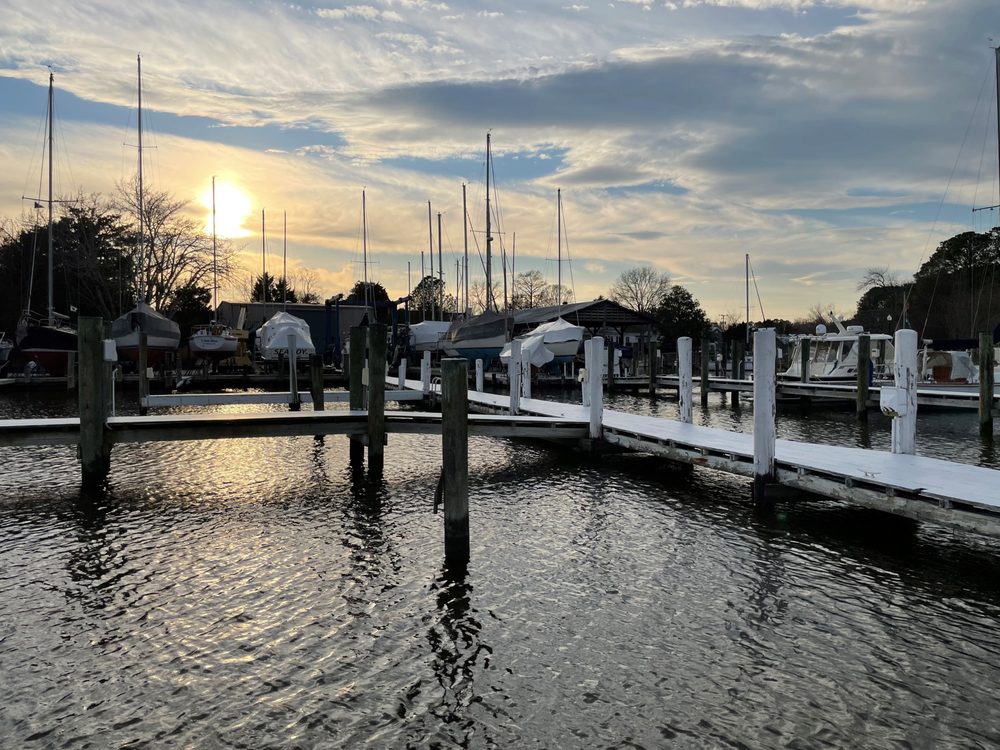
St. Michaels Marina is the primary full-service facility inside the main harbor, handling transient vessels up to 220 feet with fuel, dockside dining, and resort amenities. Higgins Yacht Yard, operating continuously since 1790, offers more than 50 slips plus haul-out, maintenance, and repair — the practical infrastructure that makes owning a boat here workable year-round. The Chesapeake Bay Maritime Museum marina has 55 slips along the harbor with member overnight dockage, set among the museum's exhibits and working boatyard. St. Michaels Harbour Inn, Marina & Spa sits at the harbor entrance and pairs slip rentals with resort facilities.
The sailing culture centers on the Miles River, which functions as a large sheltered playground for log canoe races, regattas, and casual cruising. A few nautical miles downriver, the Wye River is widely regarded as one of the finest anchorages on the East Coast — a fact that carries real weight with sailing buyers.
For trailered boats and paddlers, the St. Michaels Public Boat Ramp on West Harbor Road puts you straight into the Miles River. The San Domingo Creek launch at the end of Chew Avenue opens onto the calm back creeks and marshlands toward Broad Creek, and it's the local favorite for kayaks and paddleboards.
From the harbor, a short run down the Miles River reaches Eastern Bay, which opens cleanly into the main Chesapeake channel. Annapolis, Kent Island, and Oxford are all comfortable day cruises.
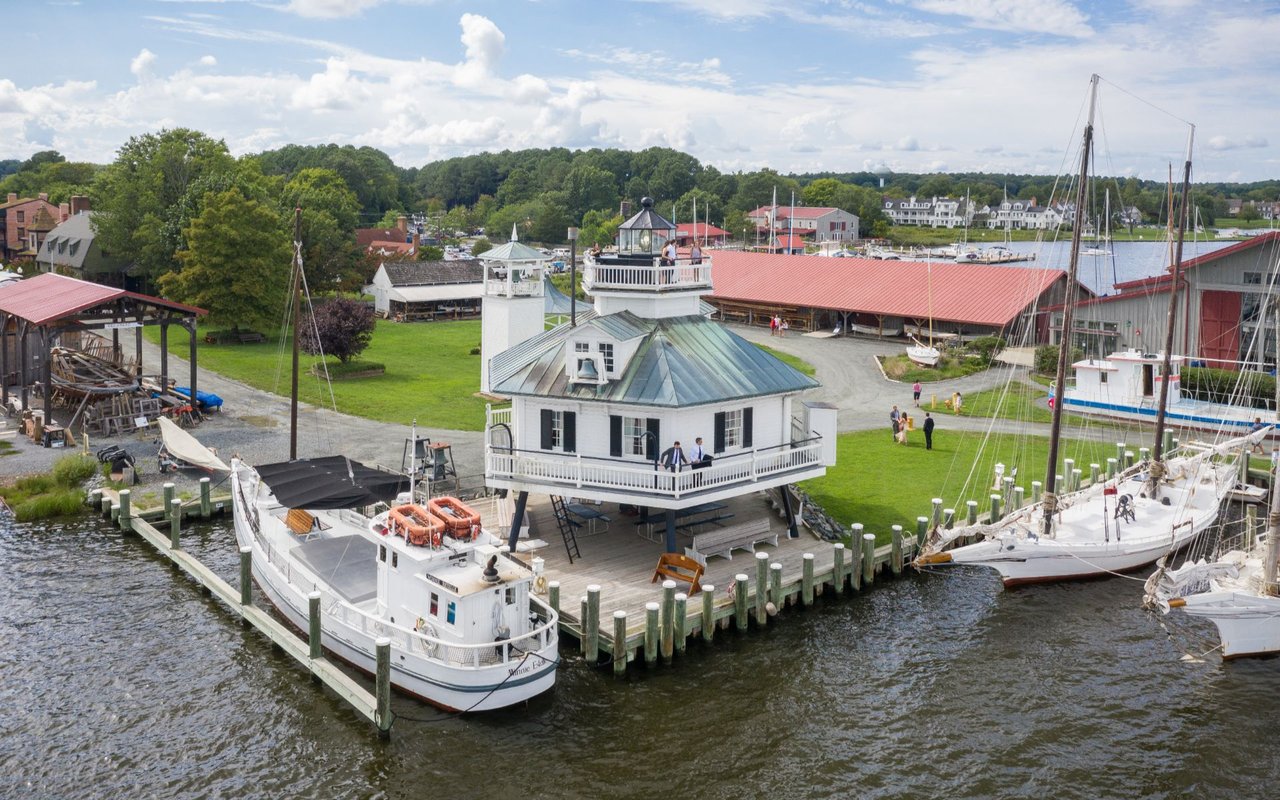
The Chesapeake Bay Maritime Museum spans 18 acres on Navy Point and is the anchor of the town's cultural life. Thirty-five buildings, the 1879 Hooper Strait Lighthouse you can climb, a working boatyard where shipwrights restore vessels in public view, and exhibits tracing the history of crabbing, oystering, and Chesapeake boatbuilding. Membership is common among residents; many treat it as a second living room.
The Classic Motor Museum on East Marengo Street rotates displays of classic cars, historic trucks, and vintage motorcycles, including a 1930s-style gas station exhibit and active restoration work on the floor.
On the water, the Patriot runs 75-minute narrated cruises up the Miles River past the historic estates and shoreline wildlife. For sailing, the ketch Lady Patty and the Selina II offer small-group sunset sails, champagne cruises, and private charters. Seasonal water taxis shuttle around the harbor between waterfront restaurants.
The seasonal calendar is worth planning around, whether you're buying or just visiting to look:
Talbot Street is the town's spine — brick sidewalks, gas-style lamps, independent boutiques, and historic inns running from the harbor south through the commercial district. It's compact enough to cover on foot in an afternoon and dense enough that you'll keep finding new things for a year.
On the water, The Crab Claw and Foxy's Harbor Grille deliver the quintessential Shore experience: steamed blue crabs, brown paper, mallets, and orange crushes with the boats going by. For fine dining, Bistro St. Michaels does seasonal French-inspired regional cooking, and Stars at the Inn at Perry Cabin serves with direct Miles River views. The everyday rotation for locals runs through Ava's Pizzeria & Wine Bar, Limoncello, Theo's Steaks, and The Galley.
The craft beverage scene is genuinely good for a town this size. St. Michaels Winery pours locally produced Maryland wines from the historic Old Mill complex. Lyon Rum at Windon Distilling produces small-batch rums and spirits. Eastern Shore Brewing, the town's oldest craft brewery, runs a taproom next to the Old Mill.
Retail leans upscale and independent — clothing, home decor, nautical gifts, and jewelers including Guilford & Company for antique estate pieces. The galleries concentrate on Chesapeake landscape work, wildlife photography, maritime painting, and regional pottery, and several owners are working artists themselves.
Families have public options directly in town under Talbot County Public Schools, plus established private schools a short drive away in Easton.
St. Michaels Elementary School on Campus Avenue serves pre-K through 5th grade, with small class sizes and heavy community involvement.
St. Michaels Middle/High School on Seymour Avenue serves grades 6 through 12 and is the smallest public high school on Maryland's Eastern Shore. That size defines the experience — roughly a 14:1 student-to-teacher ratio, students known by name across grade levels, and a school deeply woven into town life. Arts and science programs are solid, and the athletic programs, baseball in particular, are competitive.
In Easton, about 10 to 15 minutes away, The Country School is an independent co-ed K–8 with a focus on academics, character education, arts, and outdoor learning. Saints Peter & Paul Schools operate a Catholic elementary (K–8) and high school (9–12) with college-preparatory academics and competitive athletics. Chesapeake Christian School serves pre-K through 12 in a non-denominational setting.
St. Michaels feels remote, and in some ways it is — but MD-33 makes regional access straightforward once you understand the rhythms.
Easton is about 10 miles, 15 minutes, and it's where you'll do the practical business of life: Target and Harris Teeter, University of Maryland Shore Medical Center, the cultural calendar. Easton Airport (ESN) is roughly 13 miles, 20 minutes — a full-service general aviation field handling private jets and charters, which matters more than you'd expect in this market. The Chesapeake Bay Bridge at Kent Island is about 35 miles, 40 to 45 minutes. Annapolis runs 48 miles, roughly an hour. Baltimore and BWI are around 70 miles, an hour and 15 to an hour and 30. Washington, D.C. is about 75 miles, an hour and 30 to an hour and 45.
Now the part that no listing description mentions. Route 33 — Talbot Street through town — is the only main artery on and off the peninsula. On peak summer weekends, traffic through downtown slows to a crawl as pedestrians cross and drivers hunt for parking. Separately, the Bay Bridge governs travel to and from the D.C. and Baltimore metros: eastbound backs up Friday afternoons and summer Saturday mornings, westbound peaks Sunday afternoons.
Residents adapt. Locals use back roads like St. Michaels Road/MD-329 to bypass the town-center bottleneck, and they schedule off-peninsula errands for mid-week mornings. If you're considering a weekend property and plan to commute from the Western Shore, drive the route on a July Friday before you commit. It's the single most useful due-diligence trip you can make.
Property taxes here are assessed per $100 of assessed value across three layers:
Taxing authority | Rate per $100 |
|---|---|
State of Maryland | $0.1120 |
Talbot County | $0.6165 |
Town of St. Michaels | $0.4700 |
Total, inside town limits | $1.1985 (~1.20%) |
Total, outside town limits | $0.7285 |
That municipal rate is the line item buyers often overlook. Two comparable homes a mile apart — one inside the incorporated town, one just outside — carry meaningfully different annual tax bills. It's a real factor when you're weighing an in-town cottage against a Bozman or Royal Oak property.
The Homestead Credit and the second-home gap. Maryland's Homestead Property Tax Credit caps the annual increase in taxable assessment for primary residences; Talbot County limits taxable assessment growth to between 0% and 10% per year regardless of how fast the market appreciates. Second homes, non-resident vacation properties, and investment rentals do not qualify. Since the state reassesses every three years, second-home owners in a rising market absorb the full increase each cycle. In a town where second-home ownership dominates, this catches a lot of people off guard in year four.
Insurance and waterfront upkeep. Flood premiums swing hard on FEMA zone and Base Flood Elevation. High-risk AE or VE properties can run $1,200 to $5,000+ annually, while elevated homes or Zone X properties typically land in the $450–$900 range. Waterfront homeowners policies commonly carry a separate named storm or hurricane deductible expressed as 1% to 5% of insured value rather than a flat dollar figure — on a $1.5M home, that's a material number worth understanding before a storm season, not during one. Then there's the ongoing physical maintenance unique to tidal waterfront: bulkhead repair, rip-rap stabilization, and boat lift servicing, which realistically warrant a reserve of $1,000 to $3,000 a year.
None of this should scare you off waterfront. It should simply be in your model before you make an offer, not discovered afterward.
St. Michaels rewards buyers who do their homework — on water depth, on Critical Area buffers, on flood elevation, on whether that pier can actually be permitted — and it punishes buyers who assume a waterfront property in Maryland works like one anywhere else. That's the work our team does every day.
Chesapeake Bay Properties, led by Brian Gearhart and based in Easton, has spent decades on the Eastern Shore, and our clients range from first-time buyers to second-home owners purchasing deep-water estates on the Miles River. If you're buying, we'll help you sort in-town from out-of-town, protected creek from open water, and a good listing from one with a problem that shows up at settlement — and we'll open doors to off-market inventory when it exists. If you're selling, we'll price accurately for a market where the first thirty days matter most, and market your property to the high-net-worth buyer pool across the Washington, Baltimore, Philadelphia, and New York corridors where St. Michaels buyers actually come from.
Whether you're a year out or ready to look this weekend, we're happy to talk it through — including the questions that don't have easy answers.
Reach out to Chesapeake Bay Properties 31 Goldsborough St, Easton, MD 21601 (410) 310-5179 | [email protected]
There's plenty to do around St. Michaels, including shopping, dining, nightlife, parks, and more. Data provided by Walk Score and Yelp.
Explore popular things to do in the area, including Ruse, Healing Grounds Coffee, and Olivin's.
| Name | Category | Distance | Reviews |
Ratings by
Yelp
|
|---|---|---|---|---|
| Dining | 0.05 miles | 107 reviews | 4.5/5 stars | |
| Dining | 0.06 miles | 0 reviews | 0/5 stars | |
| Dining · $$ | 0.07 miles | 16 reviews | 5/5 stars | |
| Dining · $ | 0.09 miles | 53 reviews | 4.3/5 stars | |
| Dining | 0.09 miles | 0 reviews | 0/5 stars | |
| Dining · $ | 0.09 miles | 106 reviews | 4.5/5 stars | |
| Dining · $$$ | 0.13 miles | 19 reviews | 4.6/5 stars | |
| Dining | 0.14 miles | 31 reviews | 3.5/5 stars | |
| Dining | 0.14 miles | 7 reviews | 5/5 stars | |
| Dining | 0.16 miles | 7 reviews | 4.9/5 stars | |
| Dining · $ | 0.17 miles | 128 reviews | 4.3/5 stars | |
| Dining · $$ | 0.17 miles | 39 reviews | 4.6/5 stars | |
| Dining · $$ | 0.18 miles | 147 reviews | 3.8/5 stars | |
| Shopping | 0.1 miles | 4 reviews | 5/5 stars | |
| Shopping | 0.12 miles | 8 reviews | 2.5/5 stars | |
| Shopping | 0.14 miles | 1 review | 1/5 stars | |
| Shopping | 0.14 miles | 0 reviews | 0/5 stars | |
| Shopping | 0.15 miles | 15 reviews | 3.9/5 stars | |
| Shopping | 0.19 miles | 3 reviews | 4.7/5 stars | |
| Active | 0.12 miles | 61 reviews | 4.5/5 stars | |
| Active | 0.12 miles | 0 reviews | 0/5 stars | |
| Active | 0.16 miles | 1 review | 4/5 stars | |
| Active | 0.17 miles | 4 reviews | 3.5/5 stars | |
| Beauty | 0.15 miles | 1 review | 5/5 stars | |
|
|
||||
|
|
||||
|
|
||||
|
|
||||
|
|
||||
|
|
St. Michaels has 653 households, with an average household size of 2.11. Data provided by the U.S. Census Bureau. Here’s what the people living in St. Michaels do for work — and how long it takes them to get there. Data provided by the U.S. Census Bureau. 1,381 people call St. Michaels home. The population density is 1,185 and the largest age group is Data provided by the U.S. Census Bureau.
Total Population
Population Density Population Density This is the number of people per square mile in a neighborhood.
Median Age
Men vs Women
Population by Age Group
0-9 Years
10-17 Years
18-24 Years
25-64 Years
65-74 Years
75+ Years
Education Level
Total Households
Average Household Size
Average individual Income
Households with Children
With Children:
Without Children:
Blue vs White Collar Workers
Blue Collar:
White Collar:
Find Your Perfect Lifestyle
31 Goldsborough St Easton, MD 21601
31 Goldsborough St Easton, MD 21601